I designed and implemented the skating controller, trick chaining, score multipliers and progression in Unreal Engine. I also built the levels used to test them. The technical design work connects player movement to a recognized trick, then connects that trick to scoring and progression.
MOVEMENT IN DEVELOPMENT
A test space for movement decisions
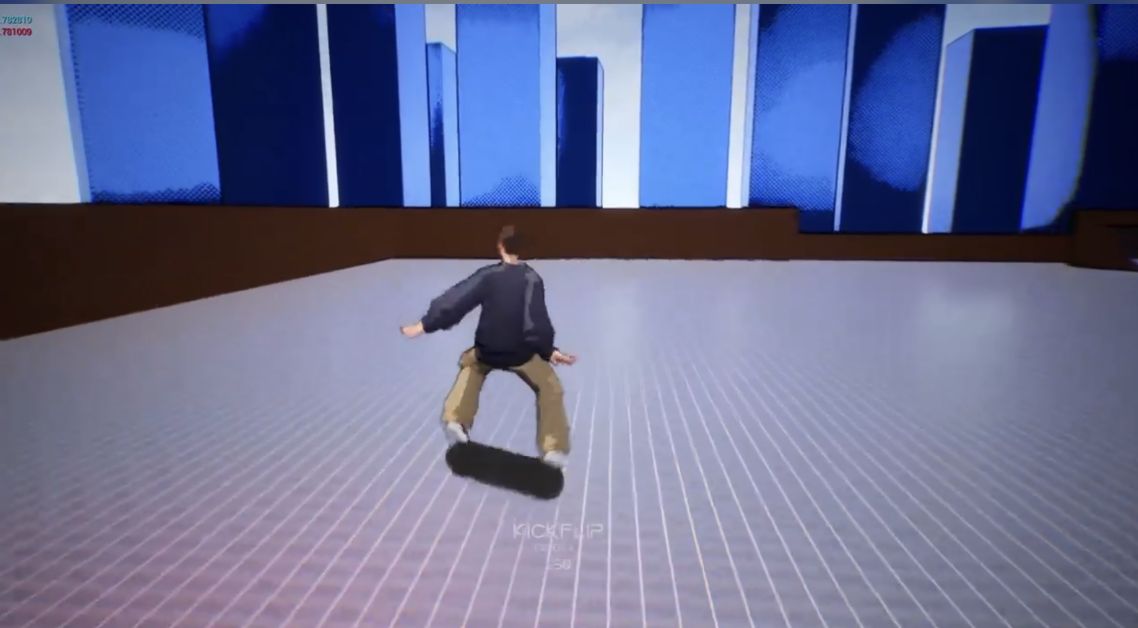
The blockout park gives the controller a small set of obstacles and surfaces to work against. Trick labels and score feedback make the result of an attempt visible. That makes the test space useful for looking at movement and timing together, before the visual detail of a finished level makes those relationships harder to isolate.
01 / TRICK FEEDBACK
A kickflip with its on-screen trick label and score feedback.
Concrete Grind is built around carrying momentum into a sequence of tricks. Movement creates the opportunity, trick chaining connects actions, and scoring gives the sequence a result. The original test levels bring those parts together in a playable prototype.
SYSTEMS DESIGN RATIONALE
Reward continuity between tricks
The multiplier gives the player a reason to keep a line going. That shifts some of the challenge from performing a single trick to preparing the next one. It also gives the controller a design requirement: movement needs to support the transitions that the scoring system rewards.
DESIGN BREAKDOWN
Read input, action & outcome together
I use the park to look at three connected layers: how the character moves, how tricks link and how the score responds. Keeping them visible in the same test space helps separate a movement problem from a scoring or feedback problem. The footage demonstrates the prototype and its feedback, rather than a finished balancing pass.