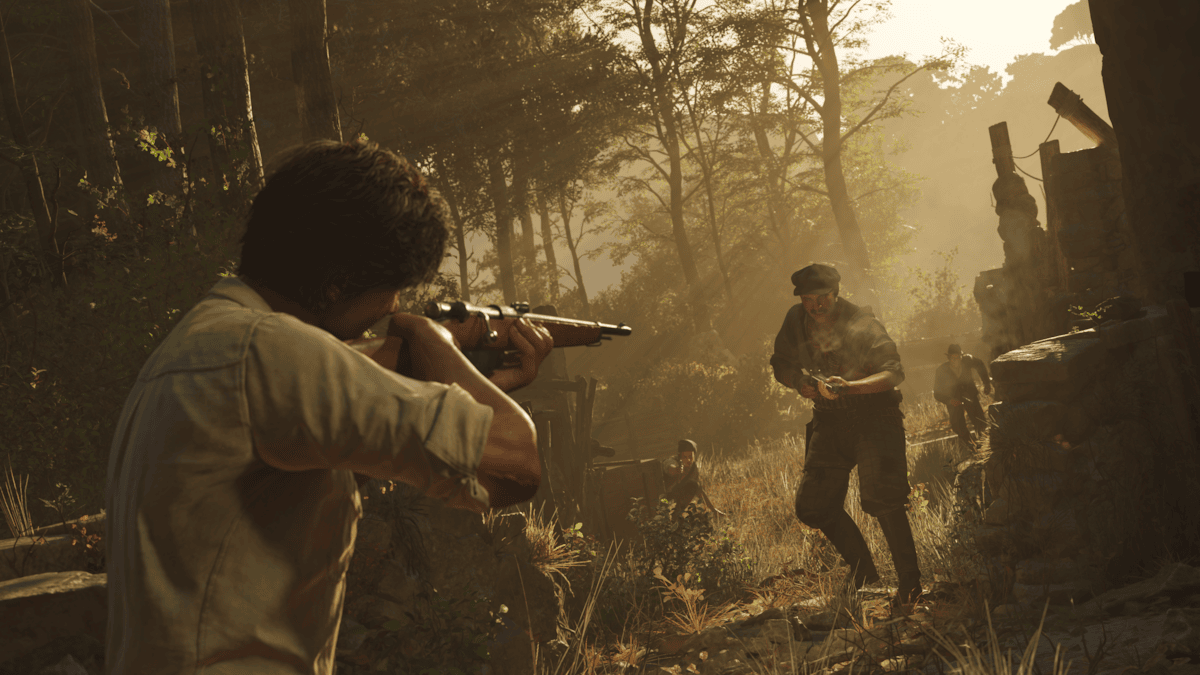
Game imagery illustrates the design topics below; individual captures are credited in their captions. Image source ↗
01 / MY CONTRIBUTION
Stealth actions & detection feedback
My contribution focused on stealth. The central design relationship is between a player action, what an enemy can notice and the feedback that follows. A player should have enough information to decide whether to wait, move or take a risk. That makes the clarity of the action-and-response relationship as important as the difficulty of the encounter.
Cover, guard-position feedback and a stealth objective help the player plan the next move. Gameplay capture: VGTimes.
02 / DESIGN LENS
Sightlines, cover & route decisions
Stealth turns a space into a sequence of exposure decisions. Cover and sightlines shape the available routes; feedback helps the player judge the risk of moving between them. The design balance is to make the situation readable while leaving room for uncertainty. Too little information makes a failure difficult to understand; too much removes the need to observe and plan.
Architecture, cover and sightlines — official environment screenshot.
03 / DESIGN LENS
Detection as a change in play
Detection matters because it changes the player’s next decision. Feedback needs to communicate that change clearly enough for the player to react, whether that means repositioning or dealing with an encounter. This is the transition I focus on in the breakdown: how the game moves from planning under uncertainty to responding to the consequences of being seen.
Open combat provides a contrast to stealth’s quieter pacing — official gameplay screenshot.Back to all work ↗